
3 posts tagged with "Infrastructure Operations"

Infrastructure monitoring, incident response, and operations automation

View all tags

Responding to AI-Era Security Threats with AI-MiWork Guard

· 4 min read
Minisoft AI Platform Tech Blog Author

Reading a security advisory is not the same as completing the response.

MiWork Guard finds what needs attention, prioritizes the work, and revalidates the result. AI organizes the evidence and risks; administrators decide how to respond. The process becomes a trustworthy record.12
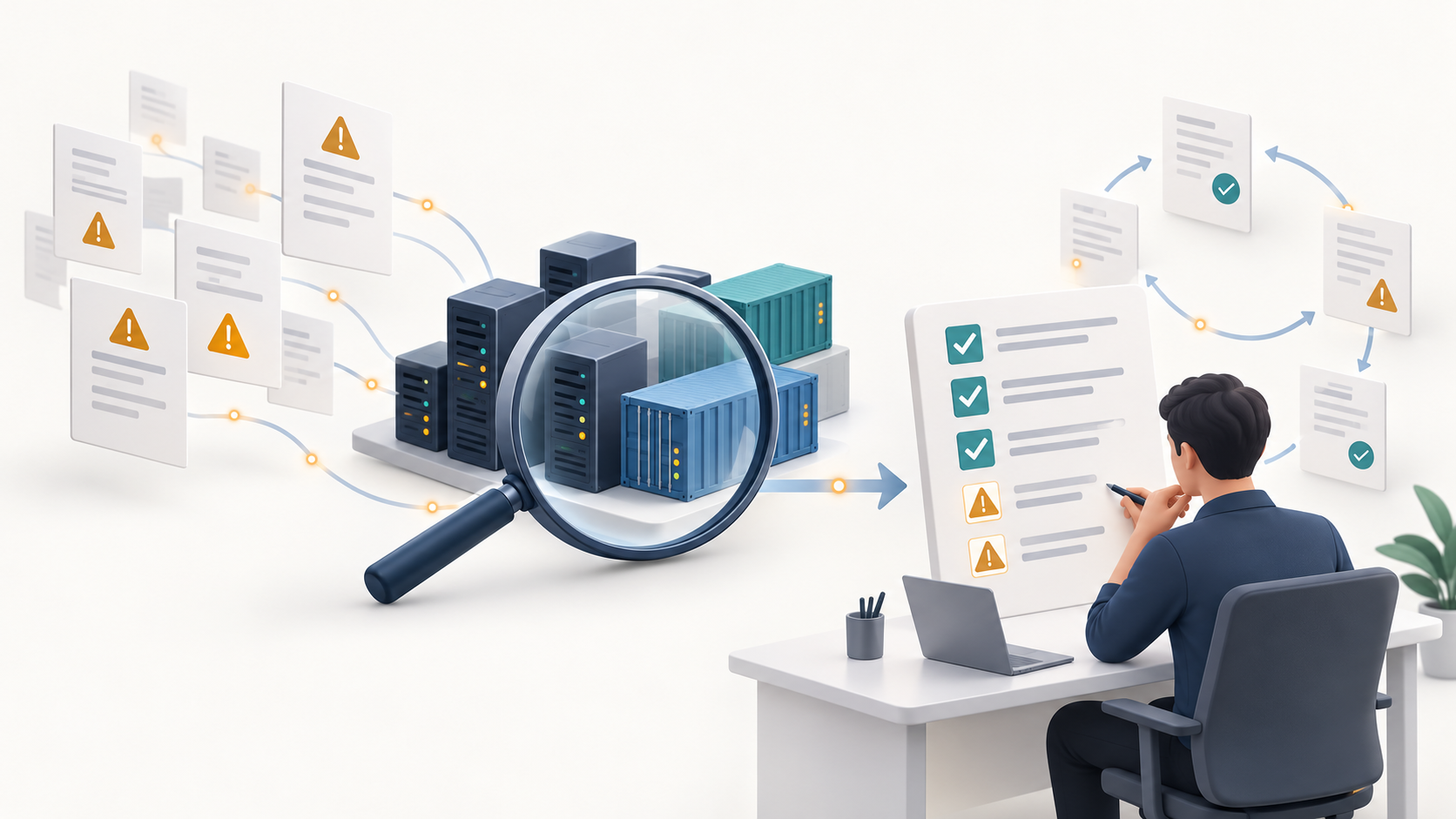
Illustration connecting security advisories with inspection and administrator-led action

An illustration of the product's purpose, not an actual screen. Click any image in the article to view the original.

Why it matters now​

AI can increase the speed and scale at which attackers find and exploit weaknesses. Preparing for new threats must go hand in hand with basic work to reduce known risks.3

Recent incidents leave a familiar task:

  • On October 12, 2026, GitLab released important security fixes and urged affected users to update promptly.4
  • The investigation into LiteLLM's compromised October 21 release described a previously exposed administrative key that had not been revoked.5

When a vulnerability has an effective fix, applying the security update in time can close the corresponding attack path. Other issues require actions beyond updating software. NIST's description of patching as preventive maintenance includes applying the relevant fixes and verifying the result.6

The practical challenge comes next. Purchased products, open-source programs, and libraries publish notices and updates on different schedules. Keeping track of what affects the company, who addressed it, and what remains is not easy.

Turn findings into prioritized work​

MiWork Guard compares software and components observed on servers with security information. The report answers three practical questions:17

  • Where is the affected software? Its location and current version.
  • What should change first? Target versions and work priorities.
  • Can it be fixed now? Fix availability and items whose actual use needs confirmation.

AI reviews collected evidence and organizes risks that deserve further attention. It supports the administrator's judgment rather than making arbitrary changes to the server.1

Turn a long list of warnings into work someone can carry out. Action plans and task lists can be saved as reports or spreadsheet-compatible files and shared with the person responsible.7
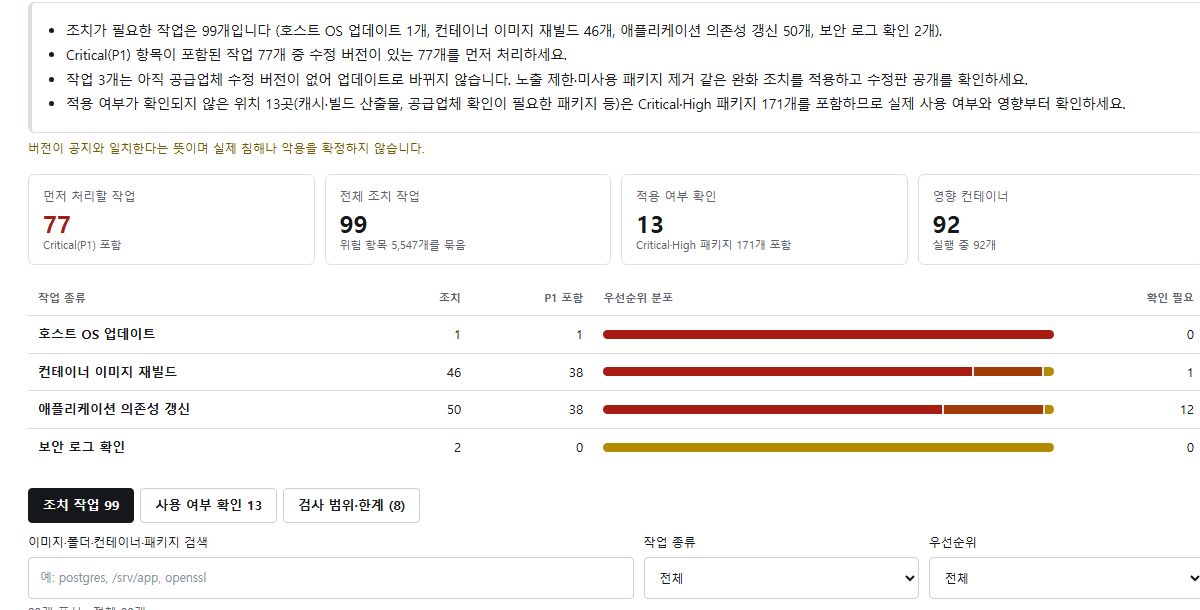
Actual action-plan screen showing priority summaries and work categories

Actual action-plan screen. Internal identifying information is excluded.
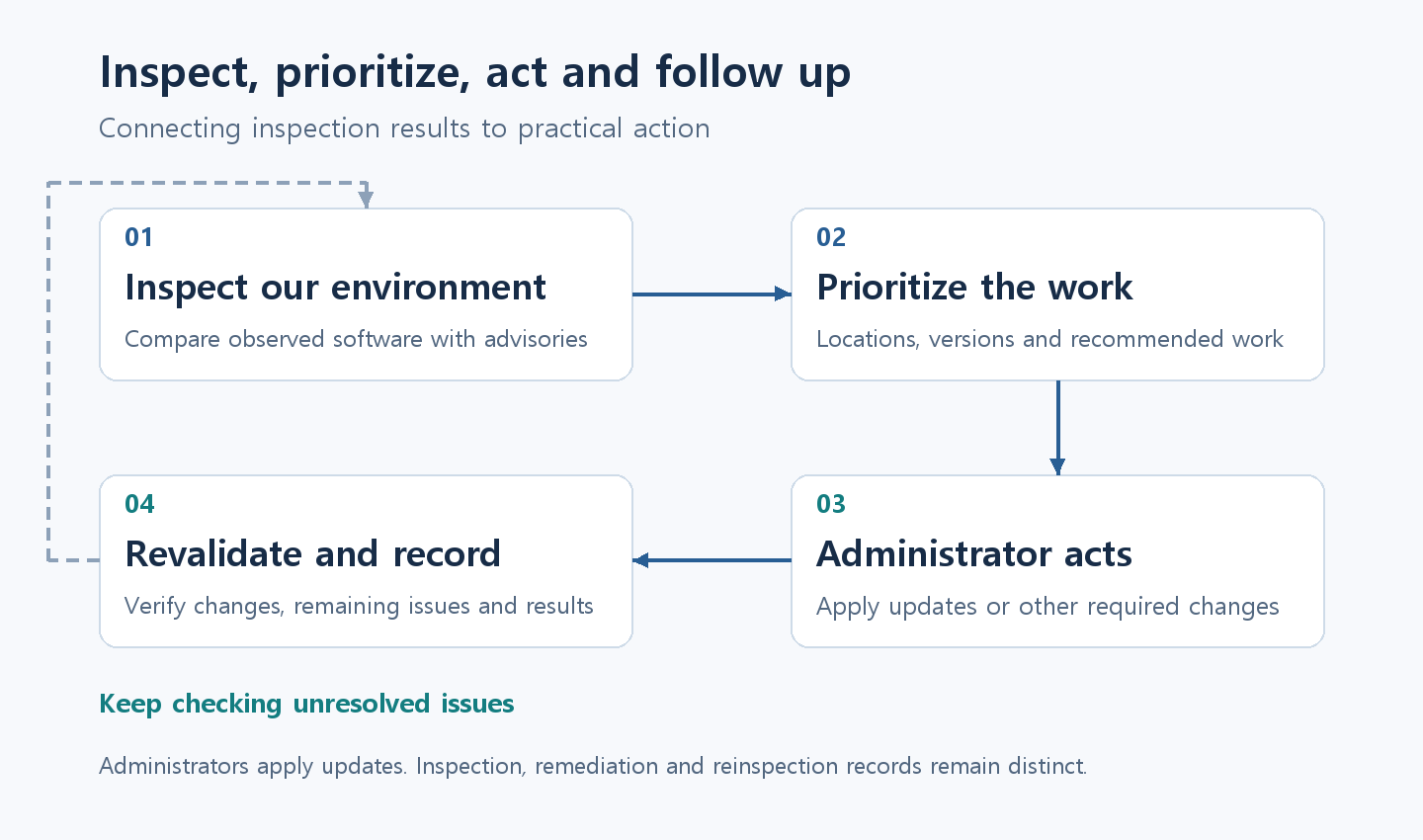
Four steps from inspection and prioritization to administrator action, revalidation, and records

Revalidate the result and keep the record​

A completed inspection is not a completed update. After the administrator performs remediation, another Guard inspection checks whether the change took effect and whether the previously observed issue remains.172

Connecting the initial findings, response records, and revalidation results shows what was found, how it was addressed, and what changed afterward. Trust comes not simply from keeping a record, but from checking the remediation result again.2

Tamper prevention protects those records. Remaining issues and uninspected areas stay visible, informing the next inspection or handover. This is not a guarantee of safety beyond the inspected scope.12
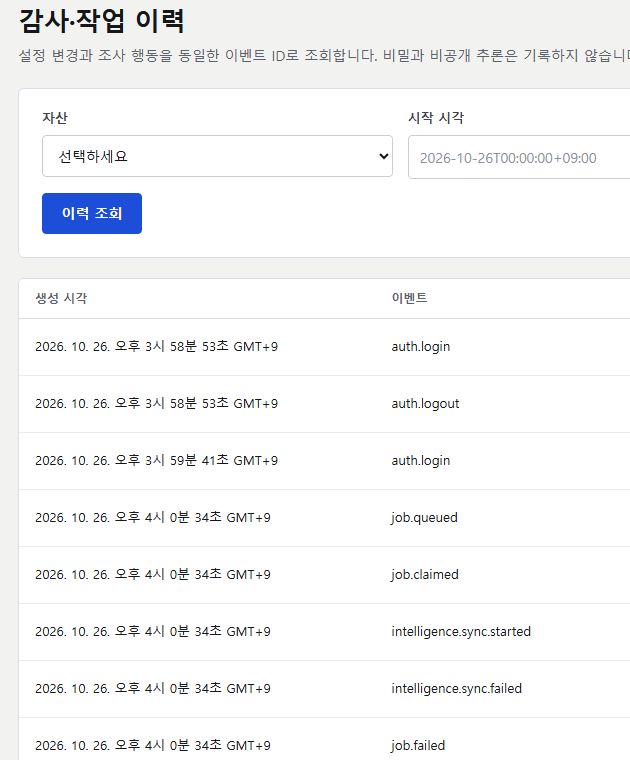
Actual history screen showing event times and activity records

An excerpt from the actual activity history. Internal identifying information is excluded.

The current scope is Linux servers and running Docker containers. Administrators perform the actual updates; areas that could not be fully checked are marked partial or uninspected.17

The gap is often not a lack of security knowledge, but the amount of work to keep in view. Reducing that gap and following through with action and revalidation is why MiWork Guard is needed.


References​

Footnotes​

  1. MiWork Guard product overview and FAQ ↩ ↩2 ↩3 ↩4 ↩5 ↩6

  2. Product owner information: existing remediation-history and evidence integration, and record tamper prevention. November 3, 2026. ↩ ↩2 ↩3 ↩4

  3. NCSC — Frontier AI: what you need to know ↩

  4. GitLab — Critical Patch Release 19.4.2, 19.3.5, 19.2.8, October 12, 2026. ↩

  5. LiteLLM — The attack chain behind the v1.107.0 LiteLLM release, incident October 21, 2026; investigation published October 23, 2026. ↩

  6. NIST — Guide to Enterprise Patch Management Planning ↩

  7. MiWork Guard product screens: investigation reports, action plans, vulnerability information, and audit history. Reviewed November 3, 2026. ↩ ↩2 ↩3 ↩4

When the Infra Alarm Goes Off - How InfraManager Answers the Operator

· 4 min read
Minisoft AI Platform Tech Blog Author

TL;DR InfraManager and MiNa aim to connect servers, DNS, certificates, containers, and ownership into one impact map when an infrastructure alarm occurs. Operators need a fast answer about what is affected, not another list of menus.

A phone rings in the middle of the night. "api.example.com is not responding." Half-awake, the operator usually thinks through the same questions. What is affected, who owns it, has this happened before, and is it safe to touch now?

It is similar to the triage that a medical team performs when a patient enters the emergency room. From one symptom, they quickly connect impact, priority, and ownership. This article focuses on what operators look at when cloud infrastructure starts to shake.

The Weight of Operating Across Five Menus​

Traditional operation screens are usually divided by menu. Server lists, DNS lists, container lists, and certificate lists are viewed separately. Each screen may be organized well, but what operators really need is the relationship between them.

If a domain goes down, which services are affected next? Who owns it? How was this handled in the past? The answers are scattered across menus, and operators have had to connect them in their heads.

In emergency-room terms, the charts are all there, but no one is doing triage. The doctor has to open each chart and build the picture mentally.

The Operation Chain InfraManager Connects​

InfraManager is an operations dashboard we are building to connect scattered information into one operation chain.

Domain -> DNS -> proxy -> container -> server -> backup -> owning team -> runbook.

When an operator selects api.example.com, the system follows this chain and unfolds everything connected to it on one screen. Instead of asking, "Where was that again?", the operator can start with, "What should we do?"

Costs are viewed in the same way. If this month's bill increased, InfraManager shows which subscription increased, which resources are tied to that subscription, and who created those resources. Following one number reveals the people and systems standing behind it.

MiNa - Triage for Operator Questions​

AI infrastructure teammate MiNa works on top of InfraManager. Operators ask in natural language, and MiNa chooses the needed tools, combines the results, and answers.

The actual questions operators ask often look like this.

  • "What is affected if this domain goes down?" - MiNa brings DNS, proxy, service, server, and owning team together.
  • "Why did this month's cost increase?" - MiNa connects subscriptions, resources, change history, and cleanup candidates.
  • "Are there servers without working backups?" - MiNa combines backup policies, failure history, and recovery targets.
  • "Has a similar incident happened before?" - MiNa retrieves past events, actions taken, and whether the issue recurred.

Just as emergency triage uses one symptom to decide the next care flow, MiNa uses one question to gather the screens, materials, and people the operator should look at next. Instead of visiting five menus, the operator asks MiNa first, and the system checks the real data.

Why We Are Building in This Direction​

The hardest part of infrastructure operations is not only checking whether a server is alive. During an incident, operators must quickly connect impact, ownership, past cases, and whether it is safe to act now, then decide the next action.

Until now, this has depended on people memorizing the infrastructure in their heads. As infrastructure grows and owners change, that approach becomes fragile. When the system remembers relationships and AI turns those relationships into answers for operators, operational pressure moves away from human memory.

Closing​

We are using InfraManager and MiNa directly for internal infrastructure operations, building a flow where operators can ask the system first instead of relying only on their memory when a late-night alert arrives.

In the next article, we will look inside how MiNa selects tools and combines answers.

Just Looking, or Actually Touching? - The One Question MiNa Asks

· 3 min read
Minisoft AI Platform Tech Blog Author

TL;DR MiNa first needs to distinguish whether the user only wants to inspect something or actually change infrastructure. Separating read-only work from change actions is what makes AI operations fast and safe.

In the previous article, we explained how MiNa answers an operator's question by combining impact, ownership, and past cases. For a question like "What is affected if this domain goes down?", MiNa gathers DNS, proxy, service, server, and owning team together.

But operators do not always ask read-only questions. Some questions change things: "Delete this container," "Stop this GPU job," or "Lock this user account." If the same MiNa answers those questions in the same way, it becomes dangerous.

This article is about the one question MiNa asks: "Are you only looking, or are you going to change something?"

The Same Emergency Room, Two Modes​

Emergency teams do two different kinds of work. They read patient charts, and they also prescribe medicine or decide on procedures. The same doctor may do both, but the process is completely different. Opening a chart does not change the patient. A prescription can affect the patient immediately if it is wrong.

When MiNa receives an operator's question, it first makes the same split. "Is this a read-only question, or is it a change request?" The same MiNa asks and answers, but the two paths are different.

The Fast Path - Read-Only Questions​

Read-only questions can move quickly.

  • "Show me the server list"
  • "Who is using the GPU?"
  • "Where does this DNS record point?"
  • "Which team owns this domain?"

For these questions, MiNa does not need deep deliberation. It directly calls the required tool and returns the result. In emergency-room terms, it immediately opens the chart. Fast answers help operators make the next decision quickly.

The Careful Path - Questions That Change Things​

Change requests cannot move at the same speed. MiNa goes through three steps.

1. Answer the impact first with a dry run

MiNa first shows, "If this is removed, these things will be affected." Even for deleting one container, it shows the site supported by that container, the connected proxy, and log-retention policy. Nothing has actually been changed yet.

2. Check the owning team

MiNa also answers who owns the area: "This belongs to the infrastructure team," or "This requires the data team's authority." This protects operators from casually making changes outside their responsibility.

3. Wait for explicit approval

MiNa does not execute until the operator explicitly confirms. It is similar to getting consent before a risky procedure in the emergency room.

Why the Two Paths Must Be Separate​

If there is only a fast path, operations become dangerous. A change request could be executed before the operator understands its impact.

If there is only a careful path, operations become frustrating. If even simple read-only questions ask for confirmation every time, operators will stop asking MiNa and go back to clicking through menus manually.

Fast triage plus careful treatment - the same shape that helps an emergency room work well also applies to infrastructure operations. Both tracks need to exist together.

Closing​

MiNa's ability to combine answers is important, but so is its ability to know when to stop and ask the operator again. The MiNa we use every day with internal infrastructure answers quickly when speed matters, and pauses when care matters.

In the next article, we will look at the operation chain MiNa follows: how it starts from one domain and traces all the way to backups and owning teams.